
Learning lab skills as an undergraduate; reflections on summer placements funded by the Invest in ME Research charity
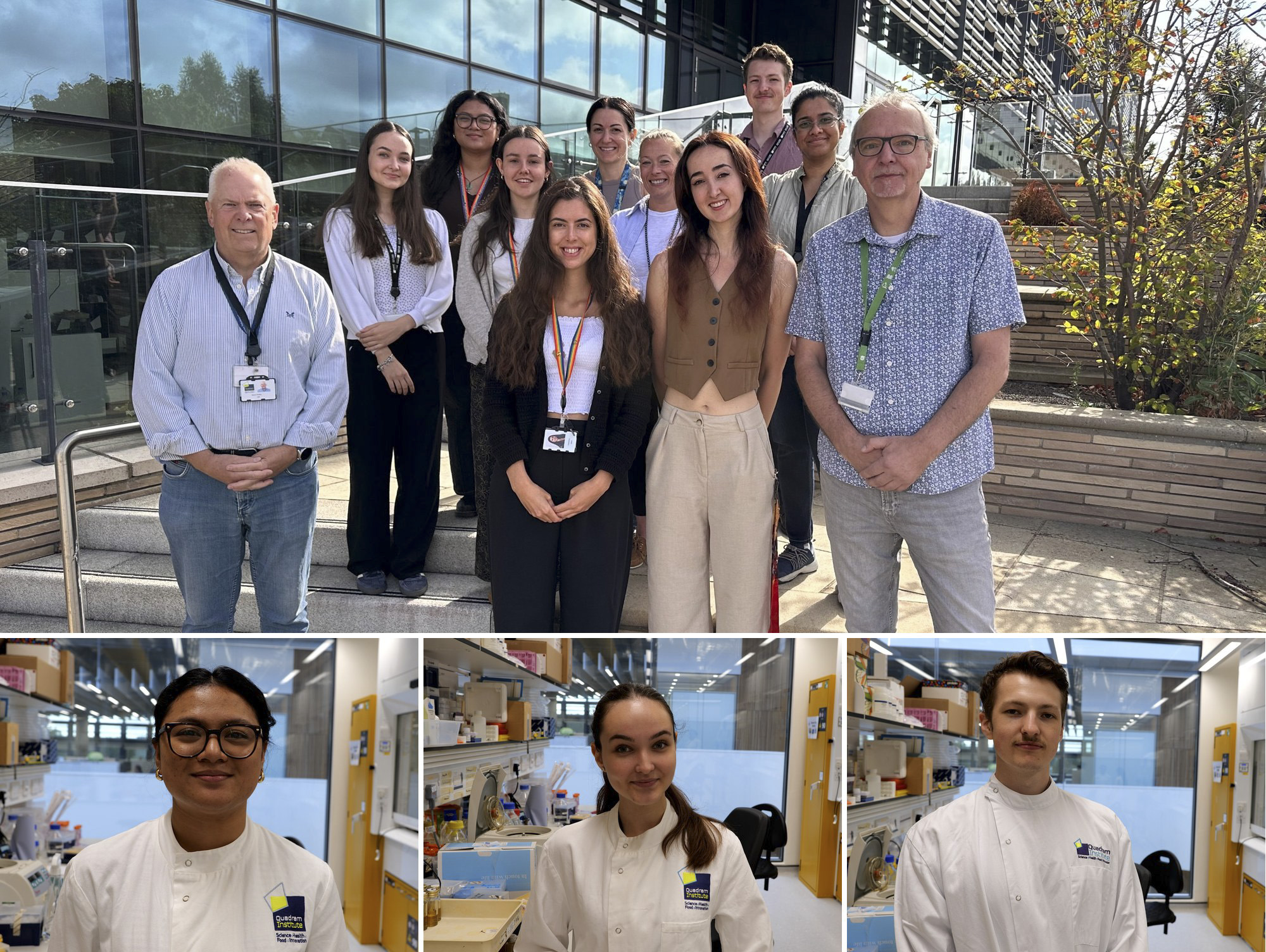
We hear from three undergraduate students about their experience spending eight weeks learning new skills and researching Myalgic Encephalomyelitis this summer.
Watch on YouTube: Summer studentships at the Quadram Institute funded by Invest in ME charity (Quadram Institute)
This summer, we spent eight weeks at the Quadram Institute in Norwich working with the ME/CFS research team, all thanks to summer bursaries generously funded by Invest in ME Research.
We all came from different backgrounds: Molly is about to start the fourth year of an Integrated Master’s in Neuroscience at the University of Southampton, Nicola is entering her final year of Biomedicine at the University of East Anglia, and Owen is a recent Microbiology graduate from the University of East Anglia. While we all had different motivations for applying, we were all connected by a shared passion for biomedical research.
Exploring ME/CFS through research
During our placement, we worked on two projects connected to areas of ME/CFS research being undertaken at the Quadram Institute. These gave us hands-on experience of the laboratory methods being used in the COMPASS-ME study, a feasibility study looking into the practicalities of studying the microbes (bacteria, viruses and fungi) that live in the nose, mouth and vagina of people with ME/CFS.
Our first project involved working with Dr Katharine Seton and Dr Rosie Young on the mucosal mycobiome (the fungal and yeast compartment of the microbiome). We created a mock microbial community to compare different DNA extraction methods and optimise fungal DNA recovery. These methods will be used to explore how microbial and fungal communities might be associated with ME/CFS, and whether they could help explain some of the condition’s symptoms and onset. We gained experience in cell culture, work in anaerobic cabinets, flow cytometry and bioinformatics, amongst many other techniques.
Our second project, with Dr Krishani Perera, focused on virus-host interactions and their potential involvement in ME/CFS. We followed the workflow from cDNA synthesis to RT-qPCR, carrying out absolute and relative quantification of gene expression.
We felt very lucky that our work in this area contributed to the development of methods used within the COMPASS-ME study.
Our understanding of ME/CFS
We all had different levels of knowledge about ME/CFS before starting the placement. Owen had personal connections to people affected by the condition, Nicola knew very little beyond its association with extreme tiredness, and Molly had researched the condition and read the blog published by previous Invest in ME Research students before applying.
During the placement, we learnt about the proposed biological mechanisms of ME/CFS, the different body systems affected and the diagnostic criteria. We also came to appreciate that ME/CFS is a very misunderstood disease: it is not simply physical exhaustion, but exhaustion that does not improve with rest. ME/CFS can severely affect a person’s physical, cognitive and emotional wellbeing, and its key hallmark symptoms can have a profound impact on education, employment and everyday activities.
Continued research is essential, as there is not yet enough evidence to explain the causes and mechanisms of ME/CFS. Nicola said she “particularly enjoyed contributing to research where there are still so many unanswered questions”.
A causal relationship has not yet been established for many of the findings being investigated. This means that promising laboratory observations cannot yet be translated directly into treatment options for people with ME/CFS.
What we learnt and how it inspired our future
Our experience at the Quadram Institute gave us an insight into what a career in biomedical research would look like. We felt very supported both in and out of the labs, and reassured that no question is a silly question, which allowed us to get the most out of the experience. We gained practical laboratory skills, as well as confidence in planning experiments, conducting research and analysing results.
Owen particularly enjoyed the practical side of research: “The part of the internship I enjoyed the most would have to be the laboratory work. The entire process of planning out an experiment and conducting it within the lab, then analysing the data, I found incredibly rewarding.”
For Molly, the placement reinforced her enthusiasm for investigating connections between the gut and the brain: “I have always been interested in the intersection of neuroscience and microbiology, but the placement has strengthened my interest in how these areas interact in disease.” She looks forward to applying what she learnt to her fourth-year research project and to her next steps, such as a PhD in gut-brain research.
Nicola’s interest in biomedical research grew during the placement, and she is now also considering a PhD, particularly exploring the relationship between microbiology and human health.
Owen hopes to take his passion for infectious disease into a pathology research laboratory, contributing to research that makes a real difference and helps people across the globe.
Supporting future ME/CFS researchers
Summer internships like this are important for the future of ME/CFS research, as they give young researchers hands-on experience of a very under-researched disease, rather than only learning about it in theory.
We thank Invest in ME Research for again funding this initiative with the Quadram Institute.
This funding gave us one of our first substantial experiences of working in a research environment.
Supporting placements like this advances knowledge in the field, encourages students to enter it
and builds a community of scientists who will go on to make a significant difference.
Every donation to the charity helps build the knowledge needed to transform the lives of people with ME/CFS.
Fund Our Fellows
Twenty years of biomedical ME research and IiMER is still a 100% volunteer-run registered charity with no salaried staff. Please support and help publicise our 20th Anniversary Appeal to keep our researchers in the laboratory.
Every pound donated goes directly to funding and facilitating biomedical research into ME, driving the science forward for people with ME.
